inventory-management-methods-warehouse-terms
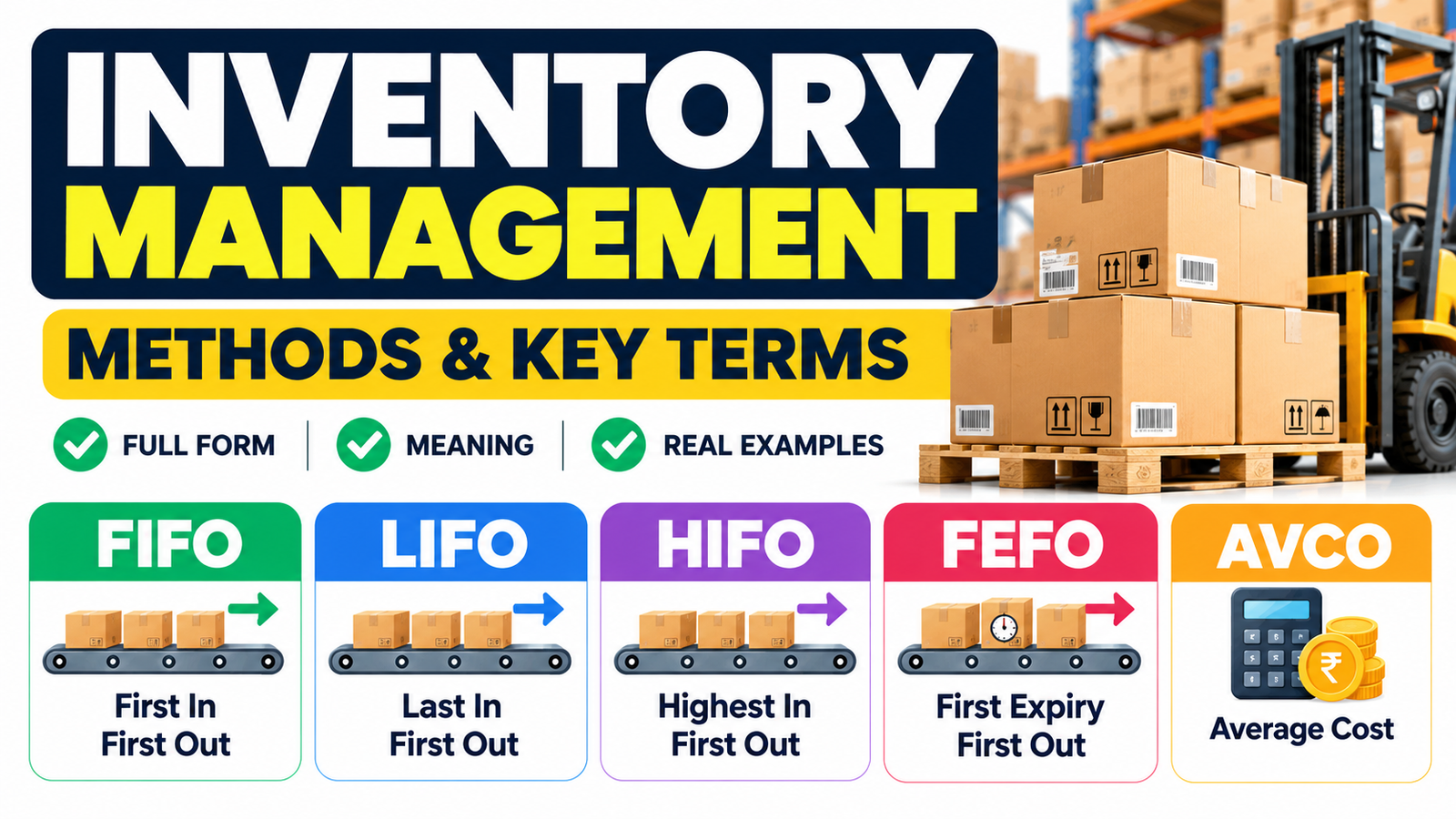
1. Introduction to Inventory Management
Inventory management is a fundamental part of logistics, warehousing, manufacturing, and supply chain operations. It involves planning, storing, tracking, and controlling goods to ensure businesses maintain the right stock levels while minimizing operational costs and wastage.
From manufacturing facilities and distribution centers to retail businesses and international shipping companies, effective inventory management helps organizations maintain smooth operations, fulfill customer orders, and optimize working capital.
Businesses handle different types of inventory, including raw materials, finished products, perishable goods, spare parts, and high-value items. Without an effective inventory management system, organizations may face stock shortages, excess inventory, product expiry, financial losses, and inefficient warehouse operations.
Several inventory management methods and valuation techniques help businesses maintain better control over their stock. Understanding these methods is essential for warehouse managers, logistics professionals, procurement teams, manufacturers, exporters, and business owners.
This guide explains the major inventory management methods, essential warehouse terminology, inventory valuation techniques, and practical strategies to improve warehouse efficiency and supply chain performance.
2. Primary Inventory Management Methods
Inventory management methods determine how goods are received, stored, issued, and valued. Selecting the appropriate method depends on product characteristics, warehouse operations, business requirements, and applicable accounting standards.
2.1 FIFO – First In, First Out
FIFO stands for First In, First Out. It is an inventory management method in which the goods received first are generally the first goods issued or dispatched.
How FIFO Works
Under FIFO, older inventory is prioritized for issuing or selling before newer stock. This helps businesses maintain proper stock rotation and minimize the risk of inventory becoming obsolete or expiring.
Example:
A food distribution warehouse receives 500 cartons of products on Monday and another 500 cartons on Thursday. Under FIFO, the Monday stock is issued first, assuming both batches are suitable for dispatch.
Key Benefits of FIFO:
- Reduces the risk of older stock remaining unused.
- Supports systematic inventory rotation.
- Simplifies stock tracking and warehouse operations.
- Helps minimize obsolescence and product wastage.
- Provides a straightforward inventory costing approach.
Common Applications:
Food distribution, retail businesses, consumer goods, pharmaceuticals, manufacturing, and general warehousing.
2.2 LIFO – Last In, First Out
LIFO stands for Last In, First Out. It is an inventory valuation method that assumes the most recently acquired inventory is issued or sold first for accounting purposes.
How LIFO Works
Under LIFO, the latest inventory purchase costs are assigned to goods sold first. This approach can be relevant for certain accounting and cost analysis scenarios, particularly when purchase prices fluctuate.
Example:
A manufacturing company purchases 100 units of raw materials at ₹100 per unit and subsequently purchases another 100 units at ₹120 per unit.
Under LIFO, the latest purchase cost of ₹120 per unit is assigned first to the units issued for accounting purposes.
Key Benefits:
- Reflects recent acquisition costs in the cost of goods sold.
- Can support specific inventory cost analysis.
- May be useful in certain accounting environments where permitted.
Common Applications:
Certain accounting and financial reporting environments, subject to applicable accounting standards.
Important Consideration:
LIFO is not permitted under International Financial Reporting Standards (IFRS). Its use depends on the applicable accounting framework and jurisdiction. Furthermore, accounting LIFO does not necessarily represent the physical movement of goods within a warehouse.
2.3 HIFO – Highest In, First Out
HIFO stands for Highest In, First Out. It is an inventory valuation approach in which the highest-cost inventory is assigned to issues or sales first.
How HIFO Works
HIFO prioritizes the highest acquisition cost when calculating the value of inventory issued or sold. It is generally considered a specialized costing approach rather than a standard physical stock rotation method.
Example:
A company purchases the same component in three batches:
- Batch A: 100 units at ₹100 per unit.
- Batch B: 100 units at ₹120 per unit.
- Batch C: 100 units at ₹150 per unit.
Under HIFO, the ₹150 per unit cost is assigned first when calculating inventory issues.
Potential Benefits:
- Helps analyze the impact of higher acquisition costs.
- Provides insight into inventory cost allocation.
- Can support internal management analysis and cost comparisons.
Common Applications:
Specialized inventory cost analysis and internal management reporting.
Important Consideration:
HIFO is not a universally accepted financial reporting method. Businesses should follow their applicable accounting standards and distinguish inventory valuation from physical warehouse picking.
3. Other Inventory Methods & Valuation Terms
In addition to FIFO, LIFO, and HIFO, businesses use various stock rotation concepts, costing methods, and pricing approaches to manage inventory and improve operational efficiency.
3.1 FEFO – First Expiry, First Out
FEFO stands for First Expiry, First Out. It is an inventory rotation method in which products with the earliest expiry dates are issued or dispatched first, regardless of their receiving dates.
How FEFO Works
FEFO prioritizes products based on their expiry dates rather than the order in which they arrived at the warehouse. It is particularly important for businesses handling perishable and expiry-sensitive products.
Example:
A pharmaceutical warehouse receives two batches of medicine:
- Batch A: Received in January, expires in December.
- Batch B: Received in February, expires in October.
Under FEFO, Batch B should generally be dispatched first because it has the earlier expiry date.
Key Benefits:
- Minimizes product expiry and wastage.
- Improves batch-level inventory management.
- Supports product safety and traceability.
- Helps businesses maintain appropriate stock rotation.
- Supports compliance with applicable product handling requirements.
Common Applications:
Pharmaceuticals, food and beverages, cosmetics, chemicals, and other expiry-sensitive products.
3.2 LILO – Last In, Last Out
LILO stands for Last In, Last Out. It describes a stock movement concept in which the most recently received goods are the last to be issued.
How LILO Works
Under a LILO-style arrangement, newer inventory remains in storage while previously received goods are issued first. This may arise from particular warehouse layouts or handling arrangements.
Example:
A warehouse stores cartons in a manner that makes the newest stock less accessible. Workers may need to move older inventory before reaching the latest received cartons.
Potential Benefits:
- May be compatible with certain storage configurations.
- Can describe specific physical stock movement patterns.
- Helps identify potential warehouse handling constraints.
Common Applications:
Specific warehouse storage and handling scenarios.
Important Consideration:
LILO is not as widely standardized as FIFO or FEFO. Businesses should define the term clearly in their warehouse operating procedures and assess whether the storage arrangement is appropriate for the goods being handled.
3.3 MOFIO – Most In, First Out
MOFIO is identified in the supplied infographic as Most In, First Out. It may describe an approach in which the largest available quantity or batch is prioritized for issuing, depending on the intended operational definition.
How MOFIO Works
When applied as a largest-batch-first approach, the warehouse prioritizes issuing a larger available lot to fulfill bulk requirements or simplify stock movement.
Example:
A warehouse has three available batches of the same material:
- Batch A: 100 units.
- Batch B: 500 units.
- Batch C: 200 units.
Under a largest-batch-first interpretation, Batch B would be prioritized for issuing.
Potential Benefits:
- May support bulk order fulfillment.
- Can simplify batch selection for large orders.
- May assist with certain stock handling and planning scenarios.
Common Applications:
Specialized bulk inventory handling, where the procedure is explicitly defined.
Important Consideration:
MOFIO is not a widely standardized inventory management method. Its meaning should be verified against the source terminology and clearly defined before implementation.
3.4 AVCO – Average Cost
AVCO stands for Average Cost. It is an inventory valuation method in which the average cost of available inventory is calculated using the total inventory cost divided by the total quantity.
How AVCO Works
Under the weighted average cost approach, businesses combine the cost of inventory purchases and calculate an average unit cost for valuation.
Example:
A company purchases:
- 100 units at ₹100 per unit = ₹10,000.
- 100 units at ₹120 per unit = ₹12,000.
Total quantity = 200 units.
Total cost = ₹22,000.
Average cost = ₹22,000 ÷ 200 = ₹110 per unit.
Therefore, the weighted average inventory cost is ₹110 per unit.
Key Benefits:
- Simplifies inventory valuation.
- Smooths out fluctuations in purchase prices.
- Supports inventory costing and financial reporting.
- Helps businesses maintain a consistent unit cost.
Common Applications:
Manufacturing, wholesale distribution, retail, and businesses handling large quantities of similar inventory.
3.5 SNP – Standard Normal Price
The supplied infographic identifies SNP as Standard Normal Price. In inventory and accounting systems, standard price or standard cost generally refers to a predetermined cost assigned to products or materials for budgeting and variance analysis.
How Standard Pricing Works
A business establishes a planned or standard price for a product or material and compares it with actual purchase or production costs.
Example:
A manufacturing company establishes a standard material cost of ₹500 per unit. During procurement, the actual purchase cost becomes ₹530 per unit.
The business can calculate a purchase price variance of ₹30 per unit against its standard.
Key Benefits:
- Supports budgeting and cost control.
- Helps identify purchase price variances.
- Provides a consistent costing benchmark.
- Assists management with financial planning.
Common Applications:
Manufacturing, procurement, inventory accounting, budgeting, and ERP-based cost management.
Important Consideration:
SNP is not a universally recognized abbreviation for standard costing. Terminology can vary across ERP systems and organizations.
4. Essential Warehouse & Inventory Management Terms
Effective inventory management requires accurate documentation, stock records, and clear material movement procedures. The following terms are commonly used in warehouse operations, manufacturing, procurement, and inventory control.
4.1 BOM – Bill of Materials
BOM stands for Bill of Materials. It is a structured list of raw materials, components, subassemblies, and quantities required to manufacture or assemble a finished product.
How BOM Works
A Bill of Materials identifies the materials and quantities needed to manufacture a product. It supports production planning, procurement, costing, and inventory requirements.
Example:
To manufacture a wooden table, the Bill of Materials may include:
- One tabletop.
- Four table legs.
- Screws and fasteners.
- Adhesive.
- Paint or finishing materials.
Key Benefits:
- Supports production planning.
- Helps determine raw material requirements.
- Improves procurement planning.
- Assists with manufacturing cost estimation.
- Supports inventory control and material availability.
Common Applications:
Manufacturing, assembly operations, engineering, procurement, and production planning.
4.2 GRN – Goods Receipt Note
GRN stands for Goods Receipt Note. It is a document or digital record confirming that goods have been received at a warehouse or business location.
How GRN Works
When a supplier delivers goods, the receiving team checks the delivered quantity, product specifications, condition, and purchase order details. After verification, the business records the receipt through a GRN.
Example:
A supplier delivers 200 cartons to a distribution warehouse. The warehouse team verifies the quantity and condition against the purchase order and creates a Goods Receipt Note.
Key Benefits:
- Provides proof of goods received.
- Supports purchase order and invoice matching.
- Maintains accurate inventory records.
- Helps identify discrepancies in received goods.
- Improves warehouse documentation and accountability.
Common Applications:
Warehousing, procurement, manufacturing, distribution centers, and supply chain operations.
4.3 GIN – Goods Issue Note
GIN stands for Goods Issue Note. It is a document or digital record used to track goods issued from inventory for production, internal consumption, transfers, or dispatch.
How GIN Works
When goods are removed from warehouse inventory, the transaction is recorded through a Goods Issue Note. This document helps maintain accurate stock balances and traceability.
Example:
A manufacturing company issues 50 units of raw material to its production department. The warehouse team records the movement using a GIN.
Key Benefits:
- Tracks inventory movements.
- Maintains accountability for issued goods.
- Supports stock reconciliation.
- Improves inventory transaction documentation.
- Helps monitor material consumption.
Common Applications:
Manufacturing, warehousing, internal material transfers, and inventory control.
4.4 STK – Stock
STK refers to stock, which represents the quantity of goods, raw materials, components, or finished products held by a business at a given time.
How Stock Management Works
Businesses monitor stock levels to ensure sufficient product availability while avoiding excessive inventory and unnecessary storage costs.
Example:
A warehouse inventory system shows 1,500 units of a product in stock, of which 200 units are reserved for customer orders. The business can use this information to calculate available stock and plan replenishment.
Key Benefits:
- Provides visibility into inventory levels.
- Supports replenishment planning.
- Helps fulfill customer orders.
- Improves inventory reconciliation.
- Supports warehouse reporting and stock control.
Common Applications:
Retail, wholesale, manufacturing, distribution, warehousing, and logistics.
4.5 ABC Analysis – Always Better Control
ABC analysis is an inventory classification technique that categorizes inventory items according to their annual consumption value or another defined business priority.
How ABC Analysis Works
ABC analysis divides inventory into three categories based on their relative importance or contribution to inventory value.
Category A – High-Value Items
These are generally high-value items that require strict monitoring, frequent reviews, and tighter inventory controls.
Category B – Medium-Value Items
These items require regular monitoring and moderate control procedures.
Category C – Low-Value Items
These are generally lower-value items that can often be managed using simpler stock control and replenishment procedures.
Example:
A warehouse handling industrial spare parts may classify expensive machinery components as Category A, moderately priced equipment as Category B, and low-cost consumables as Category C.
Key Benefits:
- Prioritizes important inventory items.
- Improves stock monitoring.
- Helps allocate inventory management resources.
- Supports more efficient purchasing decisions.
- Can reduce unnecessary inventory control costs.
Common Applications:
Manufacturing, warehousing, retail, procurement, distribution, and inventory planning.
5. How to Choose the Right Inventory Management Method
Selecting the right inventory management method depends on the nature of the goods, business operations, accounting policies, storage conditions, and customer requirements.
Different businesses may use different inventory methods based on their operational and financial objectives.
Business or Product TypeRelevant MethodMain ObjectiveFood and beveragesFIFO / FEFOReduce expiry and wastagePharmaceuticalsFEFOPrioritize earliest expiryGeneral retailFIFOMaintain stock rotationManufacturingFIFO / AVCOManage material flow and costingBulk materialsFIFO or defined physical storage strategySimplify stock movementHigh-value inventoryABC analysisPrioritize monitoring and controlsFinancial inventory reportingFIFO / weighted average, subject to accounting rulesConsistent inventory valuation
Important: Physical stock rotation and accounting inventory valuation are different concepts. A business may physically use FIFO or FEFO while applying a separate permitted accounting method for financial reporting.
Businesses should also consider the following factors when selecting an inventory management approach:
- Product characteristics: Identify whether products are perishable, expiry-sensitive, fragile, or high-value.
- Warehouse infrastructure: Evaluate storage layout, handling equipment, and available technology.
- Demand patterns: Analyze sales history, seasonality, and customer requirements.
- Accounting requirements: Follow applicable financial reporting standards.
- Operational complexity: Select procedures that warehouse teams can consistently implement.
- Technology integration: Consider whether inventory software can support the selected method.
6. Best Practices for Effective Warehouse Inventory Management
Efficient warehouse inventory management requires a combination of appropriate inventory methods, accurate documentation, skilled personnel, and modern technology.
The following best practices can help businesses improve warehouse performance and maintain better control over their inventory.
6.1 Implement a Warehouse Management System (WMS)
A Warehouse Management System helps businesses digitize receiving, put-away, picking, packing, dispatch, and stock tracking.
A WMS can provide real-time inventory visibility, optimize storage locations, and improve warehouse workflow management.
6.2 Use Barcode and RFID Technology
Barcode scanning and Radio Frequency Identification (RFID) systems improve inventory identification, transaction accuracy, and stock movement tracking.
These technologies can reduce manual data entry errors and improve inventory traceability.
6.3 Conduct Regular Inventory Audits
Regular cycle counting and physical stock verification help businesses identify discrepancies between recorded and actual inventory.
A structured stock verification process improves inventory accuracy and supports better decision-making.
6.4 Establish Reorder Points
Businesses should define minimum stock levels and replenishment triggers based on demand, supplier lead times, and safety stock requirements.
Appropriate reorder points help prevent stockouts while avoiding unnecessary inventory accumulation.
6.5 Apply Batch and Expiry Tracking
For expiry-sensitive or regulated products, businesses should maintain accurate batch numbers, manufacturing dates, expiry dates, and product movement records.
This supports traceability, appropriate stock rotation, and applicable compliance requirements.
6.6 Optimize Warehouse Layout
A well-organized warehouse layout can reduce unnecessary movement, picking time, and material handling costs.
Fast-moving products should generally be positioned in accessible locations, while storage arrangements should account for product dimensions, weight, safety, and handling requirements.
6.7 Monitor Inventory KPIs
Inventory Key Performance Indicators (KPIs) help businesses evaluate stock performance and identify areas for improvement.
Important inventory KPIs include:
- Inventory turnover ratio.
- Inventory accuracy.
- Order fulfillment rate.
- Stockout rate.
- Inventory carrying cost.
- Order picking accuracy.
- Warehouse utilization.
Regularly monitoring these indicators can help managers improve inventory planning and warehouse efficiency.
6.8 Integrate Inventory with ERP Systems
Enterprise Resource Planning (ERP) systems connect inventory operations with procurement, sales, finance, manufacturing, and reporting.
Integrating warehouse inventory with an ERP system can reduce duplicate data entry, improve information sharing, and provide better visibility across business operations.
7. The Role of Technology in Modern Logistics and Supply Chain Operations
Technology is transforming traditional inventory management into a data-driven operational process. Modern warehouses increasingly use integrated software, automation, real-time dashboards, and digital documentation to improve efficiency.
7.1 Warehouse Management Systems (WMS)
WMS platforms help manage warehouse inventory, storage locations, receiving, picking, packing, and dispatch. They provide operational visibility and support more systematic warehouse processes.
7.2 Enterprise Resource Planning (ERP)
ERP platforms connect inventory with procurement, finance, sales, manufacturing, and business reporting. This integration helps organizations coordinate business activities and make informed operational decisions.
7.3 Cloud-Based Inventory Platforms
Cloud-based inventory systems provide centralized access to inventory information across multiple locations. They can help businesses coordinate stock levels, monitor movements, and manage distributed warehouse operations.
7.4 Barcode and RFID Systems
Barcode and RFID technologies improve product identification, stock tracking, and transaction recording. These systems can reduce manual processing and support better inventory accuracy.
7.5 Business Intelligence and Analytics
Business intelligence dashboards help managers analyze stock performance, inventory costs, warehouse productivity, and operational bottlenecks.
By using inventory data effectively, businesses can identify trends, improve replenishment planning, and support more informed decisions.
7.6 Digital Integration Across Logistics Operations
For logistics companies, integrating inventory management with transportation management, shipment tracking, customer portals, and ERP platforms can provide greater visibility across the supply chain.
Digital integration can help streamline information exchange between warehouses, transport operators, freight forwarders, suppliers, and customers.
8. Conclusion: Building a Smarter and More Efficient Supply Chain
Inventory management is more than tracking the quantity of goods stored in a warehouse. It involves selecting appropriate stock rotation methods, maintaining accurate documentation, controlling inventory costs, and implementing efficient warehouse processes.
Understanding FIFO, LIFO, HIFO, FEFO, AVCO, ABC analysis, and essential warehouse documentation can help logistics professionals and business owners make better operational decisions.
As global trade continues to evolve, adopting digital inventory systems, integrated logistics platforms, and data-driven management practices can help businesses improve visibility, operational efficiency, and supply chain coordination.
By combining effective inventory management practices with modern technology, organizations can strengthen warehouse operations, improve resource utilization, and build more resilient supply chains.
9. Logistics Website Development & Digital Marketing Services
Strengthen Your Logistics Business with Digital Solutions
Managing a modern logistics business requires more than efficient warehouse operations. A professional digital presence, industry-focused website, and strategic digital marketing can help logistics companies expand their reach, strengthen brand visibility, and connect with international clients.
Business Care Solutions (BCS Group) provides specialized digital solutions for the shipping, logistics, and supply chain industry, helping businesses establish and strengthen their digital presence.
Our Key Services Include:
Logistics Website Development
Professional and customized websites for shipping lines, freight forwarders, NVOCCs, customs brokers, transport companies, and logistics service providers.
Digital Marketing
Strategic digital marketing campaigns designed to improve brand visibility, reach relevant business audiences, and generate potential business enquiries.
Search Engine Optimization (SEO)
SEO services focused on improving website structure, search visibility, relevant keyword targeting, and organic discoverability for logistics-related searches.
LinkedIn Marketing
Professional LinkedIn company page management, industry-focused content creation, B2B marketing, and brand communication to help logistics businesses strengthen their professional presence.
Custom Digital Solutions
Business websites, customer portals, and customized digital platforms tailored to the operational and commercial requirements of logistics companies.
With experience in the shipping and logistics sector, Business Care Solutions understands the digital requirements of freight forwarders, shipping companies, exporters, and supply chain businesses.
Explore Logistics Website Development and Digital Marketing Services by Business Care Solutions and discover digital solutions tailored to the shipping, logistics, and supply chain industry.